
Table of Contents
If nutrition advice feels confusing right now, that’s not because you’re bad at health.
It’s because bad nutrition advice is everywhere, and a lot of it sounds wildly confident, whether the advice-giver should be or not.
Open your phone, and one person is telling you a food is terrible. Scroll two posts later, and someone else is calling that same food healing, anti-inflammatory, hormone-friendly, gut-friendly, or whatever the buzzword of the week is. It’s all so ridiculous.
I get why so many people feel stuck. You’re not just trying to eat lunch. You’re sorting through nutrition myths, product marketing, cherry-picked science, and the steady pressure of wellness culture, which has a way of turning ordinary food into a problem to solve.
That pressure wears people down. I tend to think of it as wellness noise: all the fear-based, oversimplified, emotionally loaded messaging that makes food feel more confusing than it needs to be.
It makes you feel uncertain, then afraid, then offers a fix. Usually a powder, a supplement, a list of foods to cut out, or a set of rules that somehow expects you to have the time and emotional energy of a person who is not answering emails in the school pickup line.
So no, this post is not going to give you another dramatic list of foods to fear.
What I do want to do is help you with something more useful: sorting nutrition facts from fiction in a way that feels practical, steady, and doable in your life. Because most people do not need more noise from wellness culture. They need a better filter.
More than anything, I want you to feel a little less pulled around by every confident person on the internet with a ring light and a supplement link.
Why Nutrition Advice Gets So Weird
Nutrition advice does not come from one clean, tidy source.
It comes from a messy mix of actual research, personal experience, social media hot takes, half-understood headlines, and marketing. So someone reads one study, adds their own story, strips out the nuance, and suddenly it is getting passed around like a universal truth.
That is very different from solid, evidence-based nutrition.
Marketing makes this even worse. The easiest way to sell almost anything is to make people uneasy first. Tell them their bread is the problem. Or seed oils. Or blood sugar. Then offer relief in the form of a supplement, a protocol, or a set of food rules. Convenient.
I see this pattern all the time.
One ingredient gets blamed for basically every modern problem for six months, then it gets oddly quiet while everyone moves on to the next villain. Meanwhile, something else becomes the new miracle food.
Suddenly, people are putting cottage cheese in everything with the intensity of a late-night infomercial, as if your health has been waiting patiently for blended cottage cheese pasta sauce to arrive and save the day. (See also: cauliflower pizza crust, rice, bread, etc.)
Simple rules spread fast because they feel reassuring. “Cut this.” “Avoid that.” “Eat this one superfood every day.” “Fix it with this powder.” Those messages are neat, clear, and easy to repeat. Real nutrition is usually less dramatic. It has context. It has nuance. It depends.
Which is honest, but not nearly as catchy in a caption.
And certainty sells. A person saying, “This ingredient is terrible, never eat it,” often sounds more convincing than someone saying, “That depends on the amount, the person, and the overall eating pattern.”
The second person is usually more truthful. The first person usually gets more clicks.
Personal stories add to the confusion. If someone says, “I stopped eating this and felt amazing,” that can sound incredibly persuasive, even when it does not prove cause and effect. Stories are powerful. That does not make them useless. It just means they often get treated like stronger evidence than they are.
So if nutrition content feels loud, dramatic, and weirdly urgent, there is a reason. You are watching science, opinion, and sales all getting mixed together and presented like they mean the same thing. They do not.
Who’s Giving The Advice?
Part of the confusion is not just what gets said, but who is saying it.
Some people giving health and wellness advice have no real education in nutrition, health, or medicine at all. They just sound confident, look thin and polished, and know how to tell a compelling story on the internet.
Other people do have healthcare training, but they’re speaking way outside their actual scope or education. Having a credential in one area does not automatically make someone an expert in nutrition. I see this come up a lot with doctors because people assume medical training means they are experts in all areas of health, including in-depth nutrition training. That’s simply not the case.
This is a big reason I wrote my post on why you shouldn’t get nutrition advice from your doctors. It’s not anti-doctor, but is pro-staying in your zone of genius.
And to make things more “fun,” some people are really well educated in nutrition and still choose to sell fear, oversimplification, and nonsense because it works or makes money.
Credentials matter, but they are not magic. A person can have legitimate training and still use it to grift. That’s why “Do they have letters after their name?” is only one question. It is not the only question.
So if nutrition content starts to feel loud, dramatic, and a little unhinged at times, there’s a reason. You’re watching science, opinion, and sales all getting stirred together in the same bowl and then served as if they’re the exact same thing. They are very much not.
Why wellness claims spread so easily
- Fear gets attention
- Certainty sounds authoritative and convincing
- Personal stories feel powerful
- Products need a problem to solve
How Wellness Culture Turns Food Into a Problem
Wellness noise is the kind of nutrition content that sounds smart, urgent, moral, or a little exclusive, but does not actually help you eat well in real life. It gives you a lot to worry about and not much to do besides panic, overthink your groceries, or buy something.
You start out looking for dinner ideas and somehow end up being told your yogurt is ruining your hormones. That is wellness noise. So is the steady drip of content that makes normal eating sound reckless and highly restrictive eating sound disciplined.
It borrows the language of health without doing the work of being helpful.
It can sound informed. It can sound caring. It can even sound scientific or evidence-based.
But if the end result is that you feel more afraid of food and less clear on what to make for lunch, something has gone sideways.
It also tends to show up in a few very recognizable forms. Once you know the patterns, it gets easier to spot.
| Type of claim | What it sounds like | Why it’s a problem |
| Demonizing whole foods or ingredients | “Never eat seed oils.” “Fruit has too much sugar.” “Processed food is toxic.” | It turns one food or ingredient into a villain and ignores the bigger picture of how people actually eat. These foods are more often than not cultural or budget-friendly options, causing someone to feel that eating healthy has to be expensive. |
| Turning one nutrient into the only thing that matters | “You need to hit this protein target or your meal doesn’t count.” “Carbs make you fat.” | It reduces food to one number and pushes people to ignore context, satisfaction, culture, and overall eating patterns. |
| Using “natural” as a stand-in for safe or better | “This is all natural, so it’s healthier.” | Natural does not automatically mean safe, helpful, or more nutritious. Hemlock is natural too, and nobody is putting that in a smoothie for wellness. |
| Claiming one food fixes everything | “Eat this every day for better hormones, gut health, inflammation, energy, and longevity.” | It promises way too much from a single food and makes nutrition sound like a magic trick rather than a pattern and a science. |
| Making normal eating sound dangerous, or disordered eating sound healthy | “You should never eat after 7.” “You need to earn carbs.” “Cravings mean you lack willpower.” | This can normalize guilt, rigidity, and fear while dressing up harmful behaviors as “clean” or “committed.” |
| Acting like everyone has the same needs | “Everyone should cut gluten.” “Every woman needs this supplement stack.” | It treats individualized advice like a universal rule, which is how people end up following plans that were never meant for them, spending more money than they need to, or, worse, taking supplements that are harmful. |
Dietitian’s Tip:
A useful nutrition message should make everyday eating feel clearer and more doable. If it leaves you afraid of basic foods or convinced you need a full lifestyle overhaul by Tuesday, that’s a sign to step back.
Even if you agree with the overall idea (such as following a veg*an diet) you should look at the messenger and the information with a critical eye.
Some wellness noise is mostly harmlessly silly. Annoying, yes. A little eye-roll-inducing, absolutely. Putting cottage cheese in every recipe on earth is not necessarily a problem; though it’s not a solution either.
But some of it goes further than silly. Some of it increases fear, guilt, or restriction. Some of it chips away at trust in your own body. Some of it makes people feel like normal eating is a moral failure unless they follow a very specific set of rules. This all worsens mental health and the overall quality of your life, and can actively worsen your health.
That’s the part I care about most. Because nutrition advice does not have to be perfect to be helpful, but it does need to make your life better. If it makes food feel more stressful, more confusing, or more loaded than it already is, there’s a good chance you’re not looking at wisdom. You’re looking at noise and nonsense.
Common Nutrition Myths in Wellness Culture
A lot of wellness content looks different on the surface, but underneath, it tends to recycle the same few myths.
That’s part of why it can feel so convincing and so exhausting. You go to the grocery store for ordinary things like bread, yogurt, pasta, peanut butter, maybe a bag of frozen vegetables, some beans, and suddenly half the store feels suspicious.
You once heard that food is too processed. And that one’s not high-protein enough. Something else is too sugary, too inflammatory, too refined, too “toxic.” It’s a great way to make a normal pantry feel like a crime scene.
Most of this noise falls into a handful of patterns. Once you start noticing them, it gets a lot easier to separate actual nutrition information from recycled wellness nonsense.
This food is bad for everyone.
This myth takes one food, ingredient, or category and treats it like a universal problem. No context, no dose, no nuance, no room for the fact that different people eat differently and tolerate foods differently.
It sounds clean and decisive, which is part of the appeal. But nutrition usually does not work that way. A food does not become harmful for every person in every situation just because it has become unpopular online. Broad food demonizing is one of the fastest ways to turn people away from perfectly normal, useful, and affordable foods.
This one nutrient explains everything.
Protein becomes the only thing that matters. Or fiber. Or sugar. Or carbs. Or “toxins,” which often does a lot of damage for a word that is rarely used correctly.
This kind of thinking reduces food to a single feature and ignores the rest. It also makes people feel like every meal has to pass some sort of nutritional purity test before it’s good enough. Real people, and eating, are more layered than that. Each food brings more than one thing to the table, and meals do not need to be nutritionally flawless to be worthwhile or healthy. In fact, there’s no such thing as a perfect food, or meal, or diet pattern.
If it’s processed, it’s automatically unhealthy.
This one sticks around because “processed” sounds scary, even though it describes a huge range of foods. Canned beans are processed. Frozen vegetables are processed. Whole-grain bread is processed. Yogurt is processed. So is tofu, for that matter.
The faulty thinking here is treating all processing as the same. It is not. Some processing makes food safer, more affordable, easier to store, or easier to prepare on a busy night. A “rule” that makes dinner harder without making nutrition meaningfully better is usually not a very good rule.
If it’s expensive, clean, or trendy, it must be better.
This myth loves fancy packaging and moral language. It suggests that the best foods are the ones with the highest price tag, the longest health halo, or the most social media buzz.
Sometimes a trendy product is fine. Sometimes it is even useful. But expensive does not automatically mean more nourishing, and “clean” is often just a vague way to make other foods sound dirty. That framing creates guilt and breaks budgets, without offering much clarity, which is a pretty reliable sign that marketing is involved.
You need to optimize every bite.
This is the myth that turns eating into homework. Every snack needs more protein. Every meal needs to do five jobs. Every ingredient has to earn its place by boosting, supporting, balancing, or fixing something.
I understand why people fall for this one. It can feel responsible. Efficient, even. Or like you’re actively pursuing your health goals.
But it also makes food feel exhausting. Most people do not need to maximize every bite. They need meals that are satisfying, reasonably balanced, and doable on a Wednesday when life is already loud.
The faulty thinking underneath all of these myths is pretty similar. They take something complicated and make it sound simple. They replace context with certainty. They make food feel riskier than it is, then position a rule, product, or identity as the answer.
That is why wellness content can seem endlessly original while saying the same five things in different fonts, volumes, and accents.
And once you see those patterns, nutrition myths start to lose their magic. You stop treating every dramatic message like brand-new information. Sometimes it is just the same old fear, repackaged.
How to Gut-Check a Nutrition Claim
Sometimes a claim sounds legitimate at first. It uses the right words. It sounds science-y. The person saying it seems confident. Maybe they even have credentials. And then you look a little closer and realize the whole thing is built on one tiny study, one dramatic before-and-after story, or a problem they just happen to sell the solution for.
That does not automatically make a claim false. But it should make you pause.
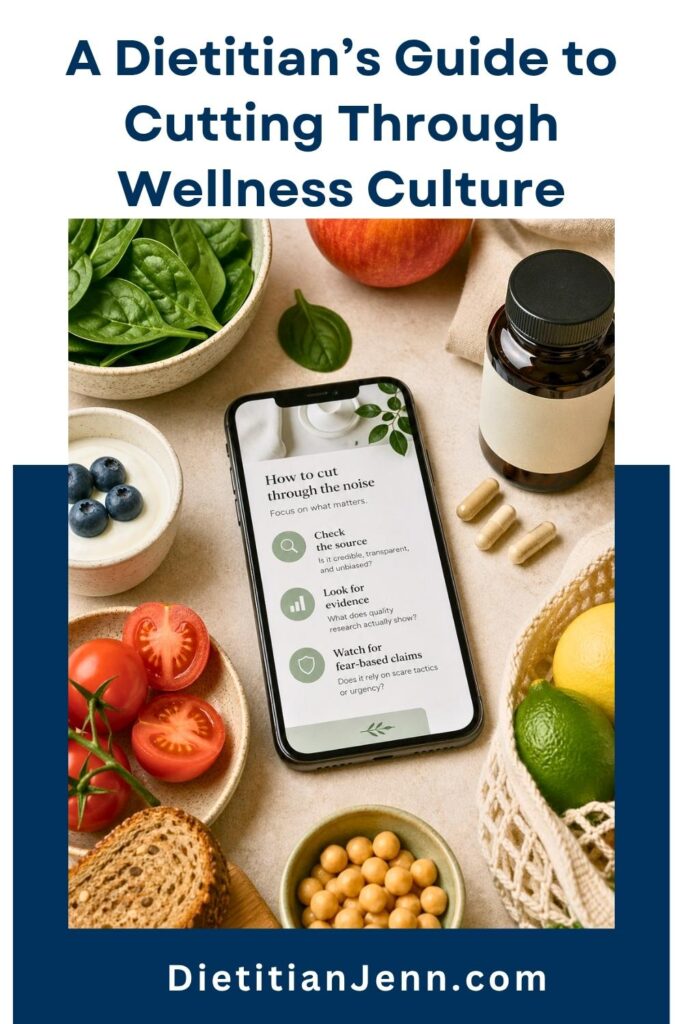
You do not need to become a full-time fact-checker every time someone on Instagram starts talking about inflammation, hormones, gut health, blood sugar, or “toxins.” You just need a few simple questions that help you slow down before you hand over your trust, your money, or your lunch.
Here are some common signs a nutrition claim deserves extra skepticism.
Is the claim dramatic or absolute?
Be careful with language like always, never, everyone, toxic, healing, or the one thing your body needs. Real nutrition advice is usually more specific than that. Absolute claims often sound strong because they leave no room for context. That is exactly the problem.
Is it trying to scare me?
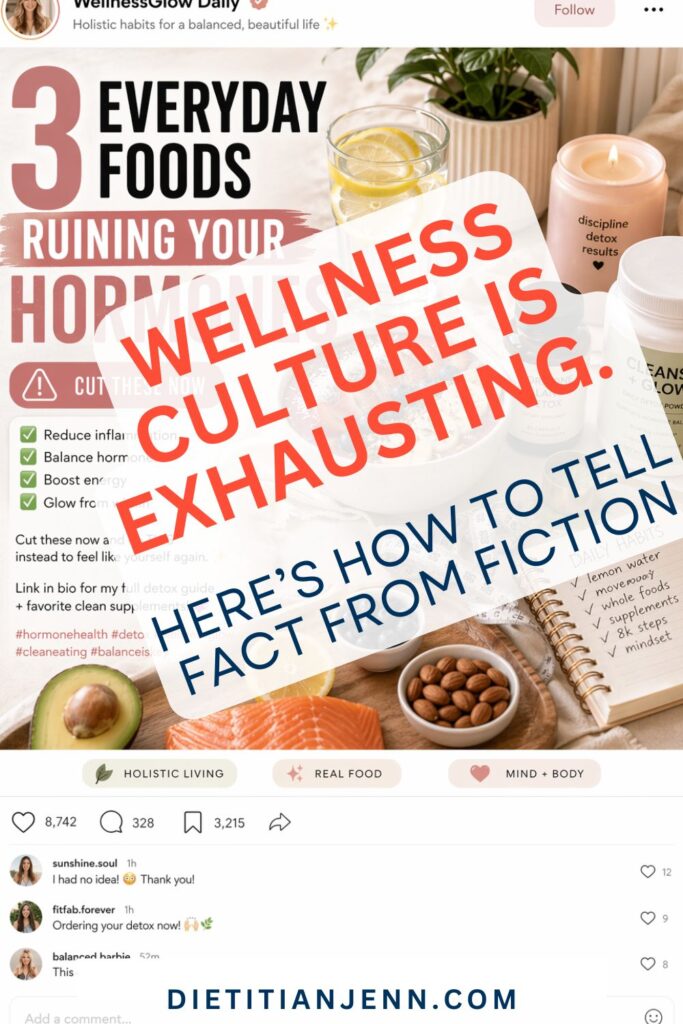
A lot of bad nutrition advice leads with fear. It tells you that a normal food is secretly dangerous or that you have been harming yourself without realizing it. Fear gets attention. It also makes people easier to sell to.
Is it based on one study, one person, or one transformation story?
One study can be interesting. One person’s experience can be meaningful. But neither one should automatically become a rule for everybody else. A single dramatic story is not the same as strong evidence.
There’s a reason anecdotal evidence is considered the least reliable.
Is someone selling the solution right next to the problem?
This one matters. If a person tells you that you have a serious issue (you didn’t know about before) and, what a coincidence, they also sell the supplement, powder, test, protocol, or membership that fixes it, your skepticism should go up a notch.
Does this advice make sense in my actual life, or only for a perfect life?
A claim can sound smart and still be useless. If the advice only works for someone with unlimited time, money, energy, food access, and emotional bandwidth, it won’t work for you.
Quick Check Before You Change How You Eat
- Is it evidence-based?
- Is it realistic?
- Is it relevant to me?
- Is it helpful, or just stressful?
Dietitian’s Tip:
Helpful nutrition advice should make your next decision feel clearer. Not harder. If a claim leaves you more anxious than informed, that’s worth paying attention to.
I also think it helps to remember that skepticism does not make you cynical. It makes you thoughtful. You are allowed to pause before believing the latest food panic. You are allowed to ask who this advice is for, what evidence it is leaning on, and whether it actually improves anything in your real life.
And yes, there are some very common signs that a claim deserves extra side-eye. I go deeper into those in my article on nutrition red flags, where I break down the patterns I see over and over again in greater detail.
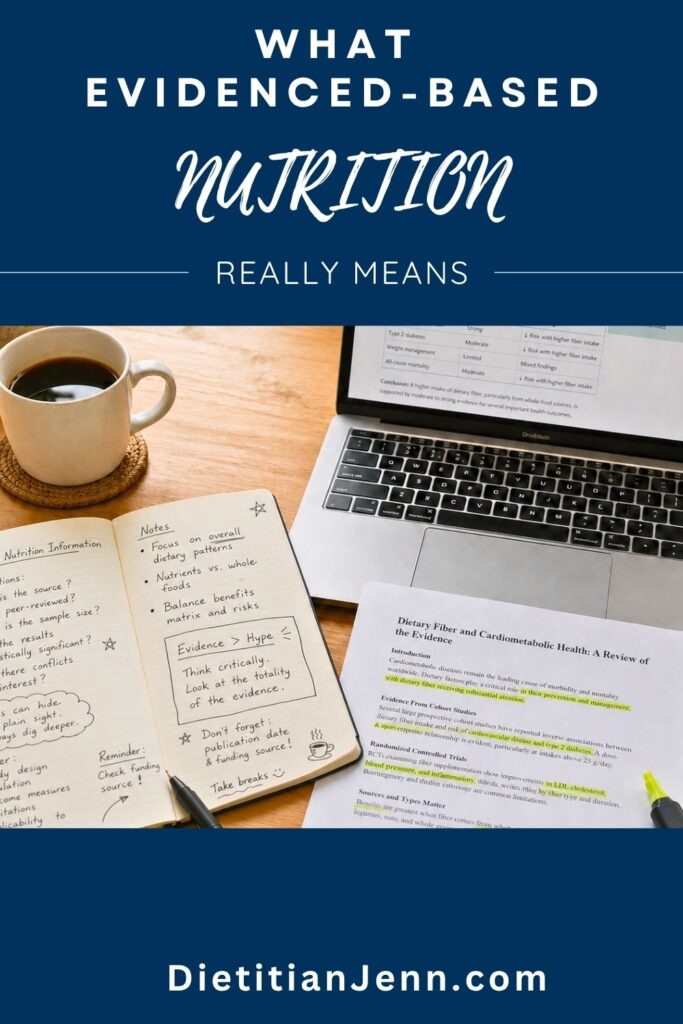
What “Evidence-Based” Really Means
“Evidence-based” gets thrown around a lot online, usually by people who would very much like you to stop asking follow-up questions. (Or by newer grads that still need to learn social media literacy)
In real life, evidence-based nutrition does not mean one perfect study came down from the heavens and settled the issue forever. It means looking at the full picture as honestly as possible. Not just one headline. Not just one chart. Not just one person on the internet who cut out a food and now feels spiritually superior in the grocery aisle.
I think of it a little like reading reviews before buying something expensive. If one stranger says, “This changed my life,” that might catch your attention. Fine. But you probably wouldn’t spend a pile of money on that alone. You would want to see more. More reviews, more patterns, more context, maybe even whether the person reviewing it seems to have normal expectations and a functioning relationship with reality.
Nutrition works the same way.
Stronger claims need stronger evidence. If someone is saying a food can cure a major problem, wreck your hormones, heal your gut, or explain every symptom you have had since 2017, that claim should come with more than one interesting study or one dramatic testimonial.
One small study is not the same as a body of evidence. Small studies can be useful. Early studies can be interesting and even exciting. They can point researchers in a direction worth exploring. But they are not the final word, and they definitely are not a license for somebody online to start yelling about what everyone should stop (or start) eating immediately.
Anecdotes can be interesting too; I pay attention to them. They can raise good questions. They can highlight experiences that deserve more study. But they are not proof. If one person says, “I stopped eating this and felt amazing,” that tells us something happened for that person.
It does not tell us why, whether it would happen for someone else, or whether that food was the real issue in the first place.
Context matters more than people want it to. Dose matters. Pattern matters. Population matters. And what the food replaces matters too. A food is not automatically “good” or “bad” in isolation. You have to ask: how much are we talking about? For whom? Under what circumstances? Compared to what?
That last one gets missed constantly. Replacing one food with another can change the picture a lot. Swapping soda for water is different from swapping yogurt for a more expensive yogurt with better marketing. Those are not the same kind of nutrition decision, even if both get dressed up as “health choices.”
This is also why evidence-based advice usually sounds less dramatic than wellness marketing. It reflects actual life. It leaves room for variation, tradeoffs, and nuance. That can make it sound less exciting, and it doesn’t feed the algorithm, but I would rather give you advice that holds up on a random Tuesday than advice that sounds amazing in a reel and falls apart the second life gets involved.
Dietitian’s Tip:
Nutrition advice that is a little less flashy, a little less absolute, and a little more grounded is often a good sign.
Why Context Matters More Than Viral Certainty
A claim can be based on something real and still get misused the second people strip away the context.
This happens all the time online. Someone learns that a food bothers some people, and suddenly it becomes a problem for everyone. Or a supplement helps people with a diagnosed deficiency, and within five minutes, the internet has turned it into a daily requirement for all women with a pulse.
That is not how nutrition works. (Or any healthcare, for that matter.)
A food that triggers IBS in one person may be completely fine for someone else, and improve gut symptoms in the next.
A supplement that is useful in a very specific situation is not automatically a smart idea for everybody. And one single meal, snack, or ingredient usually matters a whole lot less than the overall pattern of how someone eats over time.
That is why I get wary of advice that sounds very certain but skips over all the details that actually matter. Because advice without context is often junk. Maybe polished junk. Maybe expensive junk. Maybe junk with a wellness podcast microphone in front of it. Still junk.
Furthermore, real-life context is not just medical and demographics.
Budget. Culture. Preference. Access. Time. Obligations. Family life. They all matter.
When someone responds to a health claim by desperately asking you to consider context, that’s not just whining to get attention. It is the whole thing. Without it, even a technically true point can become misleading.
Questions that add some context:
- Compared to what?
- For whom?
- In what amount?
- Under what circumstances?
- Does this matter for my actual life?
That last question matters more than people think. A piece of advice can be technically interesting and still not be relevant enough to deserve your energy. And honestly, that’s good news. You do not have to treat every viral nutrition claim like a personal assignment.
What to Focus on Instead
At some point, the better question is not “What am I supposed to cut out now?” or “What gross food do I have to force-feed myself?”
It’s “What actually helps?”
Because the things that matter most for nutrition are usually not dramatic. They do not trend well. They do not come with a discount code. And they usually matter more than whatever ingredient is being blamed for society’s collapse this week.
If you want something steadier to focus on, start here:
Eat enough!
A lot of people trying to “eat healthy” end up underfeeding themselves, then wondering why they feel tired, snacky, distracted, obsessed with food, or one minor inconvenience away from losing it over a broken tortilla chip.
Get some variety over time.
You don’t need a rainbow food chart taped to your refrigerator like a threat. Just some variety over time, as you’re able. Different foods bring different nutrients, flavors, textures, and forms of satisfaction. Variety does not need to look fancy to count.
Build meals that are satisfying.
Food that keeps you full and tastes decent is doing more for most people than endlessly tinkering with one ingredient. If your lunch is technically healthy but leaves you rummaging through the pantry an hour later, you’re missing something.
Pay attention to patterns, not isolated moments.
One snack, one meal, one takeout night, or one grocery item is rarely the thing making or breaking your health. The bigger picture matters more than a single choice.
Choose habits you can repeat in real life.
The kind of habits you can keep doing on ordinary days, not just highly motivated Mondays, but can also still work on autopilot when the baby hits a sleep regression.
That may sound less exciting than whatever trend is making the rounds right now. I know. But boring, steady, useful nutrition has a much better track record than panic with good lighting.
Protecting Your Peace
There is a difference between being informed and being constantly activated.
A lot of people have started treating stress as proof that they are paying attention. Being skeptical is healthy. Being yanked into a low-grade state of food panic every time you open your phone is exhausting.
I have absolutely had moments when I closed an app because, somehow, lunch had turned into a morality test. I opened my phone, probably looking for a recipe or a reminder to thaw something for dinner, and within five minutes, I was being told that a totally ordinary food was ruining somebody’s gut, hormones, skin, metabolism, or soul.
At some point, you have to protect your brain a little.
Part of sorting nutrition fact from fiction is learning that you do not have to emotionally engage with every claim that crosses your screen. Every viral take is not a personal emergency. Every confident person is not automatically a trustworthy source. And every anxious feeling you get from a piece of content isn’t a sign that the content is important.
Sometimes it is just bad content.
Consider the following:
Unfollow fear-based accounts. If someone constantly makes food sound dangerous, ordinary eating sound irresponsible, or your body sound one snack away from collapse, you do not owe them your attention.
Oftentimes, these are people, shirtless and shoeless, hollering in a grocery store aisle, firmly in the way of anyone else in the store.
Notice how content makes you feel. If an account repeatedly leaves you panicked, ashamed, confused, guilty, or like you suddenly need to overhaul your pantry at 9:40 p.m., unfollow/block.
Stop treating every viral claim like a personal assignment. You do not have to research every scary-sounding reel. You do not have to open seventeen tabs because a stranger said your breakfast is inflammatory. Sometimes the most reasonable response is, “Maybe. Maybe not. I am not reorganizing my life around this right now.”
And choose a few trusted sources instead of endless scrolling. That helps more than people think. A small number of thoughtful, qualified voices will usually serve you better than an endless parade of hot takes dressed up as education.
(Side note: did you know that you can now tell Google which sources you trust?)
Signs a Nutrition Account Is Making Your Life Harder, Not Better
- You leave feeling more afraid or worried than informed
- Normal foods suddenly seem suspicious
- Every meal starts to feel like a test
- The advice is always urgent, rigid, or dramatic
- You keep getting pushed toward products, protocols, or paid fixes
- You feel ashamed for eating like a normal human being/enjoying food
- You trust yourself less after reading or watching
Protecting your peace does not mean ignoring evidence or pretending nutrition does not matter. It means being more selective about what gets your attention, your energy, and your trust. It means recognizing that helpful advice should bring more clarity, not more chaos.
If a source consistently makes food feel heavier, scarier, or more complicated than it needs to be, stepping back is not denial; it’s discernment.
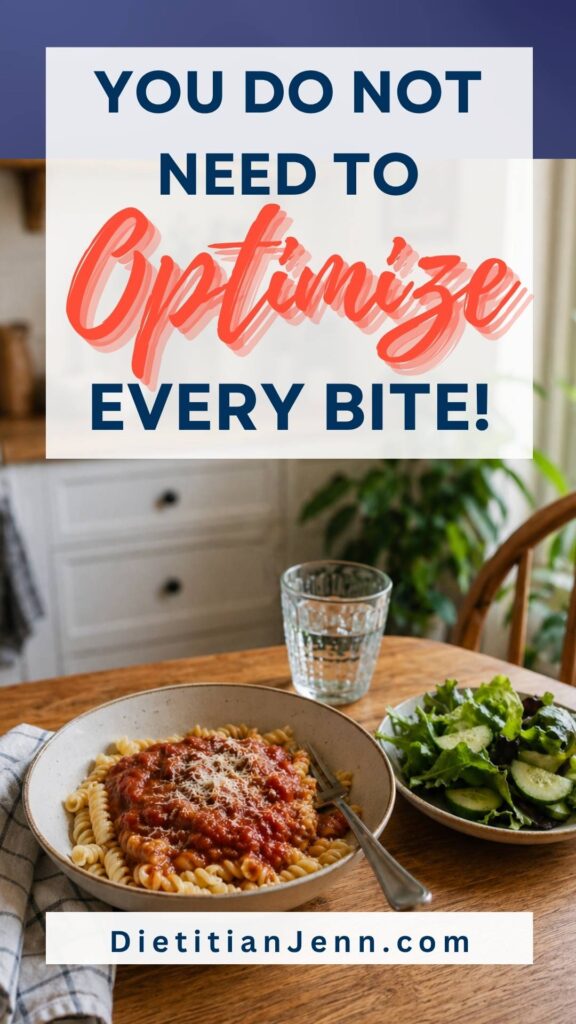
You Don’t Need to Optimize Every Bite
Trying to eat well should not feel like a part-time job.
You do not need perfect sourcing, perfect ingredient lists, or a meal plan that turns every snack into a math problem. You can care about nutrition without treating food like a performance.
A boring but decent dinner still counts. Toast, eggs, and fruit. Pasta with jarred sauce. Bean tacos. A sandwich and baby carrots on a night when nobody has much left to give. Feeding yourself in a way that is reasonably nourishing and realistic is still a win.
Food should support your life, not become another exhausting task.
If your version of “healthy eating” leaves you more anxious, more rigid, more guilty, or more tired, that is worth noticing. Because helpful nutrition advice should leave you clearer, not more afraid.
You do not need to optimize every bite. You just need an approach that helps you eat well often enough, with enough flexibility to still be a person.
Final Thoughts
If you take one thing from this post, let it be this: wellness noise usually sounds urgent, absolute, and emotionally loaded. Helpful nutrition advice is usually more grounded, more contextual, and less dramatic.
You do not need to investigate every scary food claim that shows up in your feed. You just need a few solid filters, a little skepticism, and permission to scroll past advice that makes food feel harder than it needs to be.
If you want to keep going, the next best reads are:
- How to Spot a Fad Diet for a deeper look at the common warning signs
- Why You Shouldn’t Get Nutrition Advice from Your Doctor for more on credentials, scope, and who to trust
- Common Food Myths if you want to see how these patterns play out in real examples
Because the goal here is not to make you suspicious of everything. It is to help you feel steadier, clearer, and a little harder to manipulate.
And these days, that is a pretty useful life skill to have.

Jennifer Hanes MS, RDN, LD is a registered dietitian, mom, wife, and vegetarian in North Texas. She has dedicated Dietitian Jenn to be a source of information, ideas, and inspiration for people like her, vegetarians that live with people with different dietary beliefs and/or needs in a multivore household.