




Table of Contents
📌 Editor’s Note: Why This Post Was Updated
This post was originally written to explore how marketing uses health halos to influence food choices. But as of 2025, this isn’t just about confusing packaging or trendy labels.
We’re now seeing high-ranking members of government, including HHS Secretary RFK Jr., push pseudoscientific messaging into federal policy. All while simultaneously working to undermine access to food through WIC, SNAP, and school meal programs.
That’s why this post has been updated. Not just to help you shop smarter, but to call out the real harm being done when wellness language is used to distract from dangerous, inequitable changes in public health.
Because this isn’t just about what’s on your plate. It’s about who has the right to eat, and who gets left behind when health becomes a marketing tool.
Ever stood in the grocery store holding two versions of the same product, trying to figure out which one is actually better for you?
Maybe one says “all natural,” the other says “low fat,” and the third one is in a green package that just feels healthier. You squint at the labels, get more confused, and eventually just toss the one that seems like the healthier choice into your cart.
Because you’ve got dinner to make, a million other things on your mind, and honestly? You’re trying your best.
That’s exactly where the health halo effect comes in.
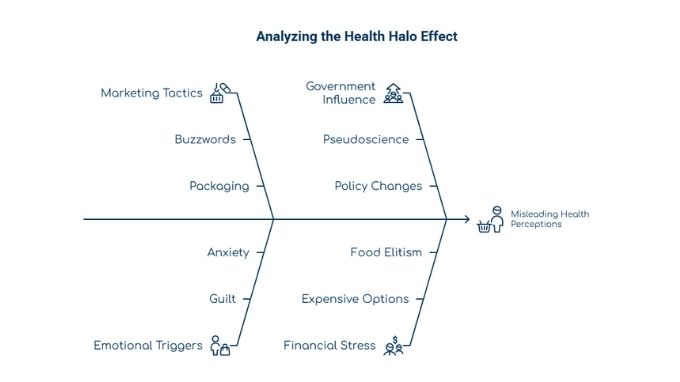
The health halo effect is a marketing tactic that makes certain foods seem healthier than they really are. It’s built on buzzwords, clever packaging, and emotional appeal—usually at the exact moment you’re already overwhelmed or trying to make a better choice for yourself or your family.
In this post, we’re going to break it all down. You’ll learn:
- What the health halo effect is (and how it shows up at the grocery store and marketing)
- Why it’s so effective, and so misleading
- Real-life examples from everyday products
- How to spot it and protect yourself from falling for it
Let’s dig in.
What is the Health Halo Effect?
The health halo effect occurs when a product appears healthier than it actually is, thanks to clever marketing rather than actual nutrition.
It might be a buzzword on the front of the package. A green label that gives off a “clean” vibe. A celebrity holding a smoothie. Or a list of ingredients that sound impressive, even if they don’t match your personal needs.
The term comes from psychology, where the halo effect describes our tendency to assume that one positive trait means everything else about something (or someone) is positive, too. For example, if someone is attractive, we might also assume they’re smart or kind, even without any real evidence.
In the world of food and wellness, that same mental shortcut shows up all the time.
If a product is labeled “organic,” “high-protein,” or “all-natural,” many people automatically assume it must be good for them. That’s the health halo in action. One appealing claim gives the entire product a glow, even if the full picture tells a different story.
Why It’s So Powerful
The health halo effect works because it taps into emotion, not logic.
We all want to feel like we’re making good choices, especially when it comes to food. So when a label promises something that sounds healthy or virtuous, it feels like a win. You’re doing something right. You’re being the kind of person who reads labels and buys the “better” option.
That’s a powerful feeling, especially in moments when you’re already stretched thin.
Maybe you’re newly postpartum and trying to eat in a way that supports your recovery and energy. Maybe you’re managing a health condition and hoping food can help. Maybe you’re just tired, overwhelmed, and trying to get dinner on the table without a side of guilt.
In these moments, we’re especially vulnerable to messages that say: This will help. This is healthy. This is the right choice. And unfortunately, those messages are often more about marketing than actual health benefits.
Dietitian’s Tip:
When we’re already unsure about food choices, a product that promises health can feel like the answer. But marketing isn’t medicine.
How the Health Halo Affects Behavior
One of the most frustrating things about the health halo effect is how confident it can make us feel about choices that don’t actually align with our needs.
It’s not that people are making “bad” choices on purpose. It’s that the messaging around certain foods is so strong, it overrides our usual decision-making, especially when we’re short on time, energy, or information.
Take kale and iceberg lettuce. Kale gets all the attention. It’s often called a “superfood,” while iceberg is brushed off as “just water.” But the truth is, both offer hydration, fiber, and beneficial nutrients. They’re different, not better or worse.
Same with sweet potatoes versus russet potatoes. Sweet potatoes are often recommended as the “healthier” option, but nutritionally, they’re actually pretty similar. Russets are higher in potassium; sweet potatoes have more beta-carotene. Which one’s better? That depends on you.
Granola and protein bars are other big ones. They look like health food, often using buzzwords like “natural,” “energy,” or “fuel.” But many are packed with added sugars or fillers that don’t support long-term energy or nutrition goals for a lot of people.
Even yogurt isn’t immune. A certain green-labeled brand is often believed to have more or better probiotics, when in reality, all yogurts are probiotic by definition. It’s the label design—and often a celebrity endorsement—that creates the illusion of superiority.
These assumptions don’t just steer us wrong in the moment. They also narrow our food choices over time. Superfood lists can lead people to focus only on a handful of trendy ingredients, leaving out plenty of affordable, accessible, and equally beneficial options.
Tansy Boggon of Joyful Eating in New Zealand puts it beautifully:
No food is categorically ‘healthy’. The quantity of said food, the entire diet an individual consumes, health conditions, medications and activity level all need to be factored into how much of a particular food is ‘healthy’.
She goes on to say:
So, for example, a product that gives the perception of being healthy because it is high in fibre or protein may not necessarily be a ‘healthier’ choice if the diet is already adequate in fibre and protein. Yes, fibre and protein are, generally speaking, ‘good’ for you, but the claim on a food label doesn’t unequivocally mean that the product is ‘healthy’ for you.
Furthermore, health claims and labeling can distract you from not-so-nutritious aspects of a product or discourage you from seeking further nutritional information—even checking out the nutrition information panel or ingredients.
And that’s really the problem.
The health halo convinces us we don’t need to check labels, or think critically, or even reflect on whether a food fits into our personal goals or preferences. We feel confident in the choice without realizing we’ve been nudged by marketing, not nutrition.
Why it can be Harmful
The health halo effect might seem like a harmless misunderstanding, but it can actually lead to some pretty serious consequences.
Let’s walk through a few of the ways it can cause real harm, especially when it interferes with informed decision-making, personal health needs, and financial stability.
False Promises Can Delay Care
When a food or product is marketed as having specific health benefits, especially without strong evidence, it can make people think they don’t need medical support.
And honestly? That’s kind of the point.
There’s a common tactic in the wellness world: convince people that traditional medicine is dangerous, corrupt, or ineffective… and then sell them the “natural” alternative. It’s genius from a business standpoint, but it can be incredibly harmful to the person on the receiving end.
If someone truly believes that a functional food or supplement will fix their gut, balance their hormones, or fight off disease, they might delay getting actual care. That can lead to more suffering, more stress, and in some cases, a worsening health condition that could’ve been treated earlier.
The appeal to nature fallacy, the idea that “natural” means better or safer, is everywhere. But natural isn’t always helpful. And marketing isn’t medicine.
Hidden Ingredients
Another tricky side of health halo marketing is the use of ingredient disguises.
As consumers get more label-savvy, food companies adapt. Sugar becomes “agave syrup,” “blackstrap molasses,” “fruit juice concentrate,” or “organic cane crystals.” Gluten-containing grains may show up as “malt,” “farina,” or “bulgur.”
For most people, that might not seem like a big deal. But for someone with a medical reason to reduce added sugar or eliminate gluten completely, these hidden ingredients can have serious consequences.
You think you’ve picked a safe product, because it’s gluten-free, “natural,” or in a health food aisle, but it’s still not aligned with your needs. And often, you won’t even realize it.
Ingredient names can get sneaky. If you have a medical condition like diabetes or celiac disease, double-check unfamiliar terms before assuming something is “safe.”r
Over or Under eating Certain Nutrients
Labels like “organic,” “non-GMO,” “no artificial colors,” or “all-natural” carry a lot of emotional weight. They make us feel like we’re doing something good. Something healthier.
But these terms don’t actually tell you anything about nutrient content or overall healthfulness.
Organic sugar is still sugar. Natural saturated fat is still saturated fat. Just because a food sounds better doesn’t mean it is better for you.
This can lead to overconsuming “healthified” products, believing they don’t count in the same way. It can also make people restrict or avoid affordable, accessible foods that are perfectly nutritious, but not labeled with buzzwords.
And the result? Less balance, less variety, and more confusion and frustration.
Financial Stress & Food elitism
Here’s where things get even more complicated.
Many of the foods that get placed on a pedestal—quinoa, kale, acai, gluten-free bread—are also some of the most expensive options in the store. And that sends a very clear message: Health costs money. If you can’t afford these products, you’re not doing it right.
But let’s look at the actual prices:
- A pound of frozen strawberries? $2.72
- A 12-oz pack of frozen acai? $5.82
- That’s 3/4 the amount of fruit for more that twice the price!
- A 1 lb bag of quinoa? $3.38
- A 1lb bag of brown rice? $0.88
- A 5lb bag of white rice? $3.34
- That’s 5 times the amount of rice than quinoa for the same money
- To compare, per ounce, the quinoa is 21¢, the brown rice is 6¢, and the white rice is 4¢ (all store brand)
- 16 oz of chopped kale? $4.76
- 16 oz of shredded iceberg lettuce? $3.84
- Whole grain bread? $1.97
- The cheapest gluten-free loaf? $5.54
Now imagine you’re working with a tight grocery budget, trying to feed your family, and someone tells you the only way to be healthy is to eat the expensive stuff. Of course, they don’t stick around to help you figure out how to get your kid to eat it.
Health shouldn’t be reserved for people with extra time, money, or Instagram-worthy pantries. But the health halo effect reinforces that idea, over and over again.
Where We See Health Halos
The health halo effect doesn’t just show up with individual foods or trendy ingredients; it’s a strategy. A very intentional, highly profitable marketing technique used across the entire food industry.
Let’s take fast food as an example.
Ask a group of people to name the healthiest fast food chain, and odds are, Subway will top the list. And if you ask for the least healthy? McDonald’s is almost always mentioned.
That’s not because of the nutrition facts. It’s because of perception.
We can thank Jared Fogle’s old ad campaign and Morgan Spurlock’s (RIP) Supersize Me documentary for shaping public opinion. One was meant to sell a brand, the other to critique it, but together they created a powerful health halo for one chain and a health villain label for the other.
But here’s the catch: Subway’s halo leads people to order cookies, chips, and soda right alongside their “healthy” sandwich, often without thinking twice. One study even found that people tended to eat more overall after eating at Subway, because they felt like they had earned it.
The glow of the halo gives you permission to stop thinking critically.
The Power of Label Claims
You’ve seen it on packaging:
- Low fat
- No added sugar
- Organic
- All-natural
- Vegan
- Plant-based
These words make products seem healthier. They make us feel like we’re making a better choice—even if the food itself hasn’t changed at all.
But a fried potato chip is still a fried potato chip, even if the potatoes were organic. And sugar is still sugar, even when it’s “naturally sourced.”
Marketing Imagery Plays a Role, Too
Health halos aren’t just built on words. They rely on visuals, too.
A milk carton with a picture of a happy cow in a green pasture feels different than one with no imagery at all. A snack bar with muted colors and leaves on the label feels more “whole” than one that’s brightly packaged.
These little choices are strategic. They’re meant to tap into how we feel about a product, not necessarily how it’s made or what’s in it.
And they work.
Examples of the Health Halo Effect
Sometimes a healthful food is over-hyped and develops a halo. Other times, food manufacturers falsely label a product with a health-promoting halo, even when it lacks any inherent health benefits.
Still, other times, healthy components are used as a vehicle for other foods that may cause harm to a person’s health.
Below I’ll list only some of the health halos that are common in the grocery store.
A great example is granola; often considered a healthy food because it contains oatmeal and nuts. However, it is often loaded with excessive amounts of sugar that the consumer is not aware of. Many protein bars follow this same MO.
Food companies frequently label veggie straws or vegetable chips as healthier alternatives to plain old potato chips. Vegetable chips are often just different starchy vegetables. These foods are perfectly fine to include in a balanced diet.
However, people often consume veggie straws or vegetable chips in larger quantities under the assumption that “they’re just vegetables.
Yogurt is another area that often sees a halo. Many people believe that a certain green packaged yogurt has more or different probiotics than other yogurts and is thus healthier. The truth is all yogurt is “probiotic yogurt.” You don’t need the more expensive name brand with the celebrity endorser.
Halo Top “ice cream” has the term halo right there in the name!
Gluten-free XYZ – the abundance of gluten-free products is great for those with Celiac disease. Those that suffer from this condition can now eat more of the foods they are used to.
However, these products also generally contain more sodium and fat than their more traditional counterparts, making them potentially harmful to the health of some individuals.
Front-of-Package Claims
There are a number of claims on packages that imply that the product inside is better than the alternative. Here is a non-exhaustive list of health claims strategically crafted to entice you into choosing them over their counterparts. They do not necessarily convey the actual healthfulness of the product.
- low fat (low-fat versions tend to have more sugar and/or sodium than the original)
- gluten-free
- organic (the term organic is actually federally regulated, but it does NOT indicate the nutrient content of the product)
- all-natural (“natural” sugar is still sugar)
- low sodium (usually contain more fat than the original)
- trans-fat-free (all food manufacturers are required to remove trans fat, and their product is no different than the next one).
In addition to the health claims, marketers frequently employ images of happy people, contented cows, vibrant green grass, and vivid blue skies to create the impression that the product is more natural and, consequently, healthier than its competitors.
- “Low fat,” “high protein,” “all natural,” etc.
- Explain how these claims don’t mean the product is healthy overall
- Examples: veggie chips, granola, yogurt brands, protein ice cream
Buzzwords and Jargon
Buzzwords get passed around because they are fun. They are usually catchy terms that are easy to remember and have been curated to make you feel a specific way about a particular product, brand, or person. Some examples include:
- plant-based (this phrase is quite literally meaningless, no one can even agree on what it means)
- Pro and prebiotics – often added (though not regulated) to products that may essentially be candy bars and cookies.
- Superfoods
- Fortified (with what? Did it need to be fortified?)
- High-protein (why do you need more protein? Protein intake higher than your needs doesn’t do much for you)
- Superfoods, plant-based, fortified, prebiotic/probiotic, “clean”
- Share how these words have no agreed-upon definitions
- Emphasize emotional marketing
Celebrity and Influencer Endorsements
Gosh, there are so many it’s hard to keep up! And now, it’s not just traditional celebrities. Companies often pay individuals with significant social media followings to endorse specific products. A couple of examples include:
- Jamie Lee Curtis and Activia
- Taylor Swift and Diet Coke
- Gwyneth Paltrow and literally anything she recommends
- The Kardashian family and various diet teas
- Jennifer Aniston and Vitamin Water
- Chrissy Teigen and Blue Apron
- Oprah and Weight Watchers
- Dr. Oz and Green Coffee Bean Extract (or anything else he says…)
- Traditional celebrities (Jamie Lee Curtis, Taylor Swift, etc.)
- Influencers paid to promote products as “wellness” items
- Acknowledge how easy it is to trust a friendly face—but remind that these are paid partnerships
Serving Size Manipulation
A more recent marketing tactic to make their products appear healthier is to reduce the serving size. Basically, food companies will shrink their portion sizes so that each serving can meet the FDA requirements for front-of-label health claims.
This is such a sneaky and backhanded way of making customers think their product has improved or is now healthier without changing a single thing!
Luckily, laws are starting to catch up, and serving sizes will have to be revamped to reflect what a normal portion size would look like, whatever “normal” means.
- Shrinking serving sizes to make nutrition facts look “better”
- Explain how this can mislead people into underestimating sugar/sodium/fat
The MAHA Movement & RFK Jr.: Undermining Science and Access
In recent months, the “Make America Healthy Again” (MAHA) initiative led by HHS Secretary RFK Jr. has pushed far beyond genuine nutrition concerns, and it’s starting to cause tangible harm in how people understand health, how science is communicated, and especially how low-income families access food.
Undermining Trust in Science
The MAHA report, released May 22, links childhood health issues to ultra‑processed foods and environmental chemicals, but it included several fabricated or misattributed studies, apparently cobbled together using AI, and left out well-supported public health threats (like firearm injuries).
Experts have called the document “not evidence-based,” “unethical,” and a misuse of public trust.
Rolling Back Public Health Programs
MAHA has energized efforts to ban soda, candy, and other processed foods from SNAP and WIC, without addressing food access or affordability. Critics warn this could punish vulnerable families rather than empower them.
At the same time, the Trump administration under MAHA is cutting funding and staff for essential nutrition and health programs (SNAP‑Ed, WIC, school meals), seriously limiting support where it’s needed most.
Listen, no one is saying sodas, candy, and “ultra-processed foods” are health-promoting. However, food deserts are a real thing. Removing those foods from SNAP eligibility will not only remove those foods from those households, they have a very real chance of removing ALL food from those households.
This is an elitist idea that sounds great in theory and makes people feel good, but only if you refuse to acknowledge the very real people that will be harmed as a result.
Why This Matters in Our Health Halo Conversation
- It’s not “just food labels.” When major players produce misleading, science-light messaging it chips away at public trust and confusion grows. Even more so at the federal level.
- It distracts from real solutions. Banning soda in SNAP might grab headlines, but redirecting funds away from food access programs does nothing to support families who are already struggling to eat.
- It reinforces elite-defined health. This movement positions certain “clean” or “organic” foods as the only acceptable choices, when many nutritious foods are affordable and accessible without hype or premium price tags.

What to Watch For (and What To do Instead)
Just like we’ve talked about with nutrition red flags, avoiding the health halo effect starts with stepping back from that automatic, emotional response we all have when we see the words “healthy,” “clean,” or “natural” on a package.
If you’ve ever bought something because it just felt like the right choice—maybe because of a green label, a familiar buzzword, or a celebrity face smiling at you from the front—you’re not alone.
But once you know what to look for, you can start making choices that are based on your needs, not just the marketing.
Emotional Triggers to Watch Out for
Before you toss something in your cart, ask yourself:
- Am I buying this because I feel guilty, anxious, or like I’m not doing enough?
- Is this product introducing a problem I didn’t even know I had?
- Would I still buy this if it came in a plain package?
That emotional pull is exactly what the health halo relies on. It speaks to your intentions; your desire to take care of yourself and your family. And then redirects it into a purchase, not a solution.
Label Reading Tips That Actually Help
The front of the label is the ad. If you really want to understand a product, flip it over and look at the nutrition facts and ingredient list.
It’s not foolproof (there are still ways to game the system) but it’s far harder to hide what’s really going on in that panel.
Here’s a quick way to match your health needs with what to check:
- Diabetes or insulin resistance? → Look at total carbohydrates, fiber, and added sugar.
- High cholesterol or heart concerns? → Look at saturated fat, fiber, unsaturated fat
- High blood pressure? → Check sodium content
And then scan the ingredients. Are there added sugars hiding under names like “fruit juice concentrate” or “evaporated cane syrup”? Is the sodium content sky-high in that “low-fat” version? These little swaps often fly under the radar when the front of the label says something comforting.
Where to Go For Real Information
If a product, or a person, makes a strong health claim, don’t stop at their blog post or podcast. Look for independent sources that aren’t selling the thing being promoted.
You may be dealing with a health halo if:
- You’re hearing the same few soundbites everywhere (“8 glasses of water a day,” “10,000 steps,” “you need more protein”)
- You have no idea where that claim originally came from
- You can’t find a single actual study cited—just opinions wrapped in “wellness speak”
Try searching on Google Scholar, PubMed, or checking reputable non-profit sites. You don’t need to be a researcher—just read a few abstracts. Can you see the connection they’re trying to make? If not, that’s a red flag.
You’ll see some overlap between health halos and the red flags of a fad (or dangerous) diet. This is because wellness influencers and other media sources develop the fad, and once the fad becomes marketable, the health halo marketing technique will follow.
Dietitian’s Tip:
Real research rarely lives in a 30-second Reel or a TikTok trend. When in doubt, check the sources or ask a credentialed pro.
What We Can Do—As Individuals and As a Community
Avoiding the health halo isn’t just about reading labels better. It’s also about seeing the bigger picture and refusing to be distracted by surface-level wellness trends while deeper issues go ignored.
Here’s how we can push back:
🔍 Hold Leaders Accountable
Demand that nutrition guidance and health policy be based on real research, not made-up studies, AI hallucinations, or cherry-picked “science” designed to push an agenda.
🛡️ Protect Evidence-Based Programs
Fight efforts to gut WIC, SNAP-Ed, and free school meals. These programs support real people in real ways. Health doesn’t happen without access to food and healthcare. Call your representatives and senators. Their contact information is available, even if some make you jump through hoops to make content. (*cough, Brandon Gill).
They may reply with a canned email response that has nothing to do with the concern you voiced, (again, looking at you, Brandon) but they are required to keep track of, and tally, their constituent’s communications, calls, and concerns.
🤔 Ask Better Question
Whenever a new policy or campaign rolls out, ask:
- Does this actually improve public health?
- Or is it just feel-good language masking cuts, blame, or inequity?
🧑🏽🤝🧑🏿 Center Equity in Nutrition
Healthy eating shouldn’t be a luxury. We need to stop pretending that kale and quinoa are the only way to nourish a family. Beans, rice, frozen vegetables, and shelf-stable basics are still nutritious.
Let’s make sure the conversation around food and health is grounded in compassion, access, and real evidence. Not empty trends or overpriced solutions.
📣 Speak Up for Equity and Real Change
We also need to speak up. Not just for ourselves, but for the communities most often left out of wellness conversations.
When politicians push policies that sound good on the surface but make access harder for low-income families, disabled folks, rural areas, or communities of color, we can’t afford to stay quiet.
Health equity means fighting for:
- Universal access to nourishing food, clean water, and safe places to live
- Support for community programs that actually meet people where they are
- Policies that build trust in science, rather than spread fear or misinformation
- A public health system that listens to real needs instead of chasing headlines
This isn’t about being perfect. It’s about being present. Paying attention. And using whatever voice or platform we have to advocate for change that actually matters.
If you’re in a position to speak up, do it. Whether that means emailing your representatives, supporting local food justice groups, or calling out harmful messaging in your own spaces. Your voice makes a difference.
Ensuring that everyone has access to food will damn sure do more to improve American’s health than a red food dye ban ever will.
Why This Matters: Creating a More Honest, Safe, and Inclusive Wellness Culture
At its core, the health halo effect isn’t just about packaging tricks or trendy food swaps. It’s about the bigger story we’ve been told about what it means to be “healthy.”
And who gets to be seen that way.
Misinformation, elitism, and wellness marketing have created a culture where health feels like a performance. Where making the “right” choices is tied to income, privilege, and who you follow on Instagram. Where people feel ashamed of eating affordable food, suspicious of science, and exhausted by mixed messages.
And all of that is deeply unfair.
Most people are just trying to do their best with the information they’ve been given. They’re making choices based on what they can afford, what their families will eat, and what they’re told will help. And when the system is set up to confuse them, or shame them for getting it “wrong,” we don’t just hurt individuals.
We lose trust. We lose community. We lose access to real health.
That’s why this matters.
We need a wellness culture that values honesty over hype. That makes room for nuance. That respects science while still recognizing the real-life barriers people face. And most of all, we need a culture that stops punishing people for being human.
That starts with demanding transparency from companies, influencers, and policymakers.
But it also takes us. To pause before we believe the next “superfood” headline, to question who benefits from the message, and to show each other grace when we get it wrong.
That’s how we begin to build something better.
Final Thoughts
The health halo effect is a powerful marketing tool that can carry serious consequences for health and wellness. By creating the appearance of healthiness (with clever packaging, buzzwords, or celebrity endorsements) companies can mislead consumers and even put their well-being at risk.
But we can do something about it.
By becoming informed and intentional, we take back control. That means:
- Reading labels carefully, not just trusting front-of-package claims
- Inspecting ingredients and health benefit claims critically
- Seeking reliable, independent sources of research
Ultimately, it’s up to both companies and consumers to demand transparency. We deserve a marketplace, and a wellness culture, that values honesty, supports health for everyone, and doesn’t rely on hype over hope.
✅ What You Can Do Now
- Connect with advocacy groups leading the charge for nutrition equity:
- The Gates Foundation works worldwide to provide nutrition and other healthcare measures to the most vulnerable populations.
- The Academy of Nutrition & Dietetics supports inclusion and eliminating systemic barriers
- The Food Research and Action Center (FRAC) fights hunger and advocates equitable food policy
- Partnership for a Healthier America works to transform food systems and improve access
- Voice your concerns to policymakers—here’s how:
- Find your federal and local representatives using tools like USA.gov, House.gov, and Congress.gov
- Call or email HHS Secretary Robert F. Kennedy Jr. via HHS (phone: 1‑877‑696‑6775, or [email protected])
- Note: The phone number will get you to HHS. Take the email with a grain of salt. Kennedy’s contact information only includes is social media accounts.
- Here’s a subreddit that gives great tips on handling the call.
- Speak up for equity-driven health:
- Advocate for continued support of WIC, SNAP‑Ed, and free school meals
- Push for research transparency, no AI-manufactured data from leaders that aren’t qualified to read scientific research.
- Support policy that centers real-world access, not headline-friendly soundbites
- Hold companies and systems accountable: health is a right, not a privilege
Thank you for sticking with me through this deep dive. The health halo might be everywhere, but so is our power to see clearly, speak up, and demand a healthier, fairer future for everyone.
FAQs
The perception that certain foods are beneficial for health, despite lacking substantial evidence to support such claims. This is a tactic that makes products appear healthier than they are, often using words like “natural,” “low fat,” or “superfood.”
This marketing technique appeals to a person’s desire to achieve a specific health goal. The marketer will use words and imagery to imply that their product is good for you, despite no research to back their claims.
People often fall this marketing tactic because they have “tried everything else,” they feel desperate, or the product introduced them to a problem then didn’t know they had in the first place.
Health halos rely on emotions and knee-jerk reactions rather than reasonable thought.
It hides the full nutrition picture, leading people to make choices that may not match their needs or goals.
Focus on the full nutrition label, look past buzzwords, and seek information from non-marketing-based sources.

Jennifer Hanes MS, RDN, LD is a registered dietitian, mom, wife, and vegetarian in North Texas. She has dedicated Dietitian Jenn to be a source of information, ideas, and inspiration for people like her, vegetarians that live with people with different dietary beliefs and/or needs in a multivore household.